



Something broke in how we evaluate designers and nobody updated the system.
I’ve been looking at portfolios recently. Not because I’m hiring, but because I’m thinking about my own.
The more I look, the more everything blends together. Problem statement, research phase, wireframes, final UI, metrics. Clean arcs, polished screens, the same story told slightly differently a hundred times.
That used to be enough. I’m not sure it is anymore.
Hiring managers get 200 plus applications for senior design roles. They spend six to eight seconds on an initial portfolio scan before deciding to dig deeper or move on.
In that tiny window, you need to communicate who you are, what kind of work you do, and whether you’re worth a conversation. And you’re competing against portfolios that were built in an afternoon by AI tools.
The new baseline
Tools have made polished portfolios much easier to create:
Taskade Genesis - Generates a full portfolio site from a single prompt, connects to Figma and Dribbble.
Case Study Designer - Turns messy Figma notes into a polished, structured case study in twenty minutes.
Figma Make - Builds a hosted portfolio page from your screens without writing any code.
A clean, well structured portfolio is now the baseline, not the differentiator. And most of us are still building for the old world.
The judgment gap
When I think about the projects I’ve worked on that had the most impact, the screens were almost never the reason. It was usually something else:
A research finding that redirected the whole approach
A conversation where I convinced the team to cut a feature
A moment where the obvious solution didn’t hold up and I had to think harder
The screens were just the output. But portfolios almost always present the output as the work.
Jenny Wen (design lead at Anthropic) said something that stuck with me: taste without accountability is decoration. Taste with accountability is leadership.
She also noted that a few years ago, 60 to 70 percent of a designer’s job was mocking up and prototyping. That’s now down to 30 to 40 percent. The role has shifted. Most portfolios haven’t.
Strong portfolios expose the structure behind decisions. If the decisions stay invisible, judgment can’t be evaluated. And judgment is what actually gets hired.
What I’m actually seeing change
The designers getting hired right now, especially at senior levels, are doing something different. Their portfolios feel less like galleries and more like arguments.
They’re focusing on showing the thinking and decision making behind the work, rather than just polished final screens. Hiring managers increasingly want to see how you frame complex problems, how you use AI without losing your judgment, and how you tie design decisions to business outcomes.
The trust question
78 percent of recruiters now use AI assisted screening to filter portfolios before a human sees them.
Candidates use AI to build portfolios. Reviewers use AI to scan them. Both sides are optimizing for the same patterns. The signal is collapsing.
This doesn’t mean portfolios are dead. But their role is changing.
The portfolio gets you into the conversation. The real decision happens in the conversation, through live walkthroughs, design exercises, and how you talk about tradeoffs in real time.
What I’m changing about my own portfolio
I don’t have this fully figured out yet, but here’s what I’ve started doing:
Lead with the decision, not the deliverable. Each case study now opens with the hardest question the project had to answer.
Include what didn’t work. The dead ends usually reveal more about how I think than the final design.
Keep fewer projects. Three strong case studies with real depth beat eight that only show range.
Add hard to generate artifacts. A short recorded walkthrough, a screenshot of a real conversation, or something that clearly shows my own thinking.
The uncomfortable part
A portfolio is not a retrospective of your career. It’s proof of how you think today.
That’s what makes this shift difficult. Most of us built our portfolios to document what we made. Now we need to document how we decided.
That requires showing the mess. The wrong turns. The constraints. The moments where you weren’t sure.
AI can generate a beautiful case study. It can’t generate the specific, messy, human process that led to a real decision under real constraints. That part is still yours, but only if you actually show it.
The designers whose portfolios feel impossible to replicate with AI won’t win by adding more polish. They’ll win by showing the parts only they could know.
Thanks for reading :) If something in this issue resonated, please reply and tell me.
Even one line. These replies are my favorite part of writing this newsletter.
See you next Thursday 🙌
— Balint
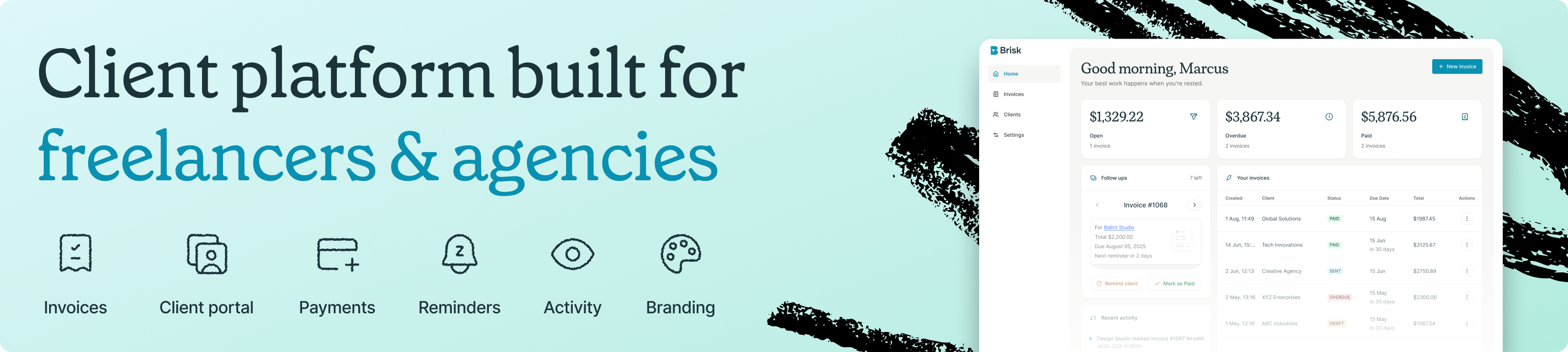
P.S. Here’s what I’m building
A calmer way to run your freelance business.
Brisk helps you give clients a professional experience: from the first agreement to the final payment.